Concept Note:
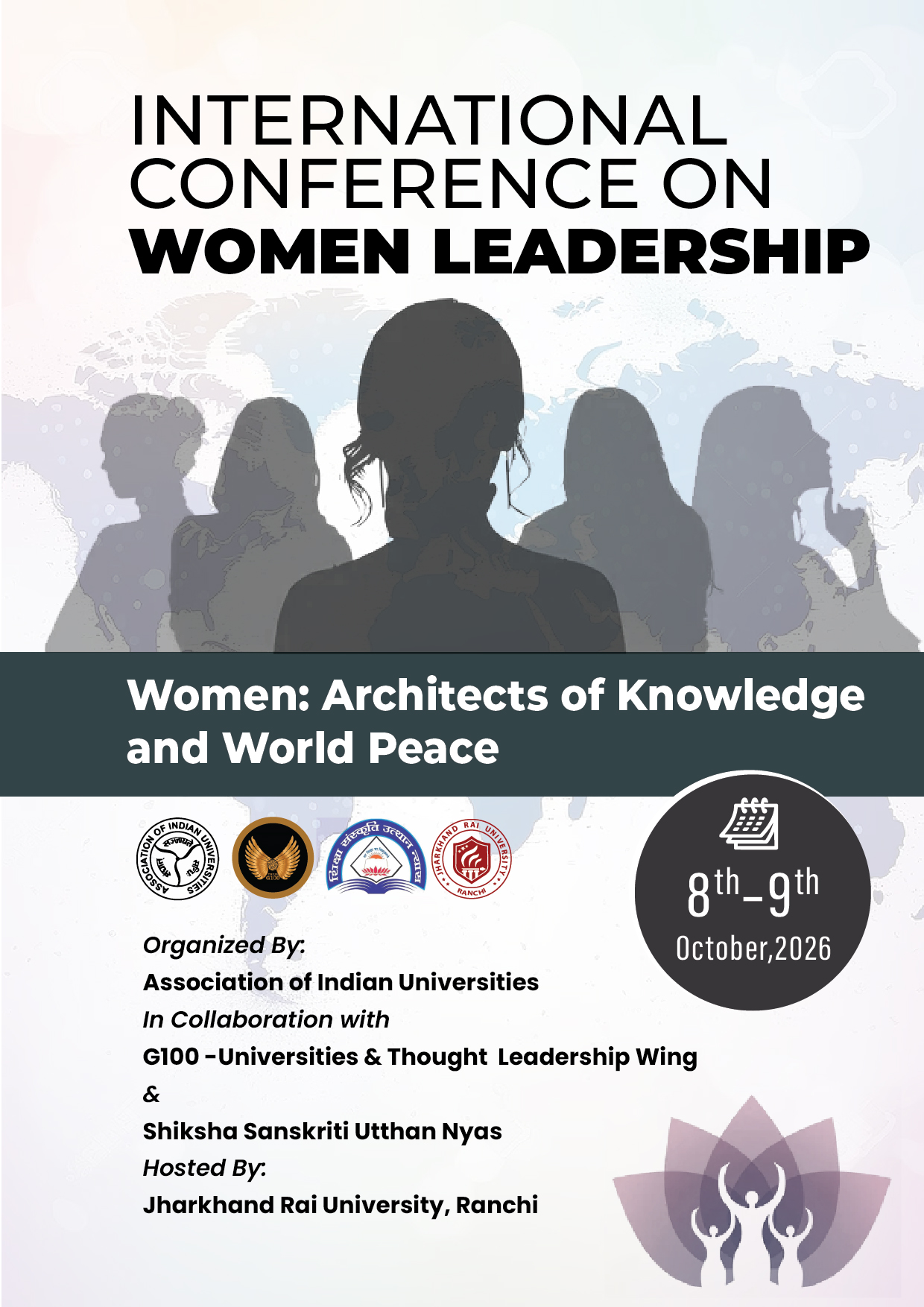
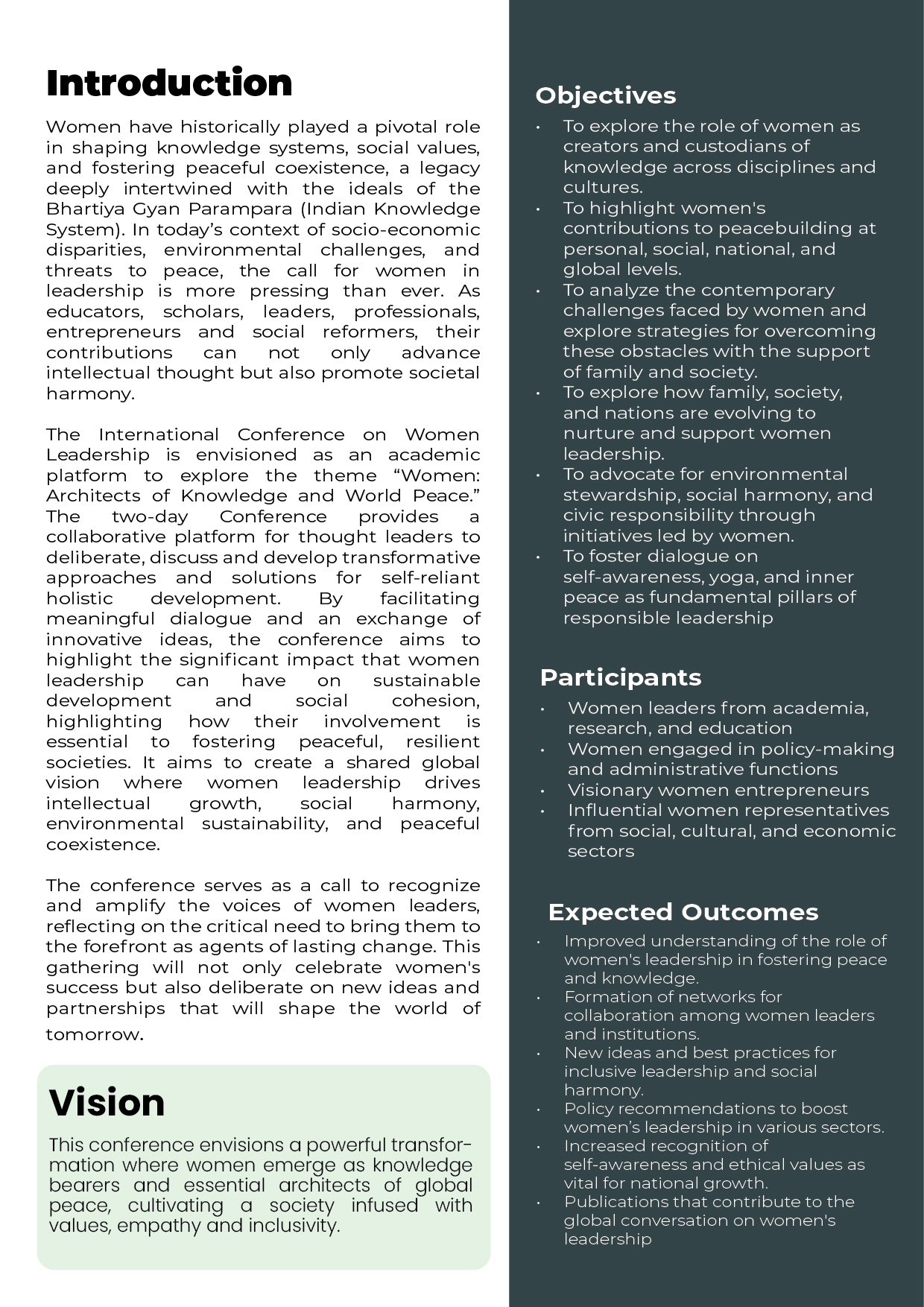
The International Conference on Women Leadership will provide a dynamic platform for thought leaders to explore transformative approaches for holistic development. The conference highlights the vital role of women in promoting sustainable development and social cohesion, aiming to establish a global vision where women leaders propel progress in intellectual growth, social harmony, and environmental sustainability.
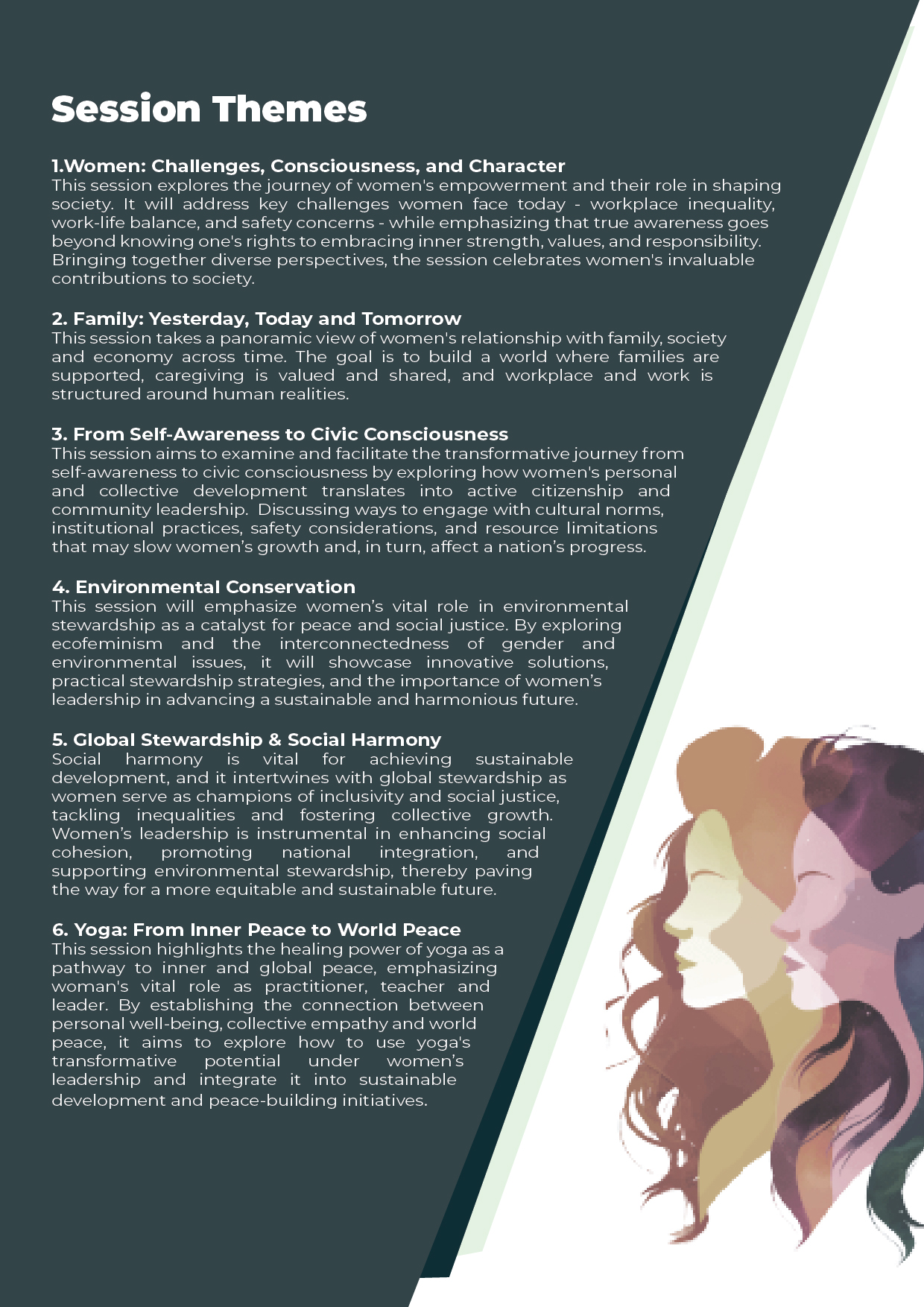
SESSION THEMES
1. The Woman of Today: Challenge, Consciousness and Character
This session aims to explore and present the comprehensive journey of today’s women, highlighting their empowerment and pivotal role in shaping society.
Challenges represent the external and systemic barriers that women continue to face today—inequality in the workplace, balancing professional and family responsibilities, safeguarding cultural values, and concerns related to safety.
Consciousness reflects awareness and self-realization at both individual and collective levels. It goes beyond mere awareness of rights; it also encompasses an understanding of one’s inner strength, values, and responsibilities. In Indian tradition, womanhood is regarded as the foundation of power (Shakti) and creation. This consciousness is nurtured through education, mentorship, and the intergenerational exchange of knowledge.
Character celebrates the strength, resilience, ethics, and values that both women and men should embody in every realm of life. It honors the qualities women develop while facing hurdles —adaptability, emotional intelligence, collaborative leadership, and moral courage. This pillar seeks to acknowledge, celebrate, and actively support women’s contributions and struggles.
This thematic progression is meaningful—embracing experiences and obstacles without allowing them to dilute our values and principles; fostering consciousness to navigate and overcome these barriers; and ultimately recognizing and honoring the character shaped through this journey. The theme invites diverse perspectives—from seasoned leaders, activists, entrepreneurs, artists and scientists to speak on how these three elements intersect in their own lives and the role of women in shaping them for future generations.
2. The Family: Yesterday, Today and Tomorrow
This session aims to present a comprehensive perspective on the relationships between women, family, society, and the economy across three dimensions of time.
Yesterday: Heritage and Learning
This section honors the past while keeping the perspective realistic It acknowledges the warmth and interconnectedness of traditional family relationships while recognizing the need for women’s autonomy and choices that supports her aspirations.
Today: Change and Strain
This part highlights the complexities of the current reality.
Changing Family Realities: Family structures are evolving, yet women often bear the unequal burden of managing careers, domestic tasks, caregiving responsibilities, and emotional labor—many of which remain invisible and unpaid.
Cultural Narratives: Society tells women they can “have it all”—a successful career, an ideal home, engaged motherhood, and satisfying partnerships; however, the truth is that these expectations are often impractical and unattainable, leading women to internalize their inability to meet them as personal failure.
Partnership Dynamics: The quality of domestic partnerships profoundly influences working women’s family experiences. Issues of equality, cooperation, and a lack of understanding among family members significantly increase women’s stress and workload.
This section acknowledges the ongoing tension between progress and entrenched structures, celebrating achievements while honestly recognizing struggles.
Tomorrow: Vision and Possibilities
This section invites imagination and aspiration, envisioning family structures beyond the traditional single-family model. It poses questions about what genuine equality in domestic work and caregiving responsibilities would look like. It considers policy innovations, community care models, and collaborative arrangements.
Grounded in optimism, it asks:
What kind of families do we want to build?
What support systems are necessary?
What healthy and balanced values do we wish to pass on to the next generation?
The session aims not for women to “do it all” but to create a world where families receive support, caregiving is valued and shared, and work structures align with human realities. This is not just a women’s issue; it relates to how we organize society, what we value, and what kind of life we want for all.
3. From Self-Awareness to Civic Consciousness
This session aims to examine and facilitate the transformative journey from self-awareness to civic consciousness by exploring how women’s personal and collective development translates into active citizenship and community leadership. The session will identify barriers and enablers in this transition, showcase successful models of women’s civic engagement across different contexts, and create actionable pathways for participants to strengthen both individual agency and collective impact.
Background and Rationale
The journey from self-awareness to civic consciousness represents a transformative pathway that is particularly significant for a nation’s progress. Self-awareness forms the foundation upon which women can build meaningful engagement with their communities and the broader civic sphere. This session explores how individual awakening and understanding each other’s strengths, rights, and potential translates into collective action and becomes a catalyst for social change.
Historically, women’s movements have demonstrated that when women develop strong self-awareness and recognize their collective agency, they become powerful agents of civic transformation. This progression from the personal to the political, from individual consciousness to community leadership, remains critical in addressing contemporary challenges including gender inequality, political underrepresentation, and social justice.
The Foundation of Self-Awareness
Exploring how women develop understanding of their identities, rights, capabilities, and worth within diverse cultural, social, and economic contexts. This includes examining the role of education, mentorship, economic independence, and support networks in building self-knowledge.
Contribution to Society
Understanding the mechanisms through which individual awareness transforms into civic engagement, including consciousness-raising practices, community organizing, digital activism, and political participation.
Leadership and Collective Action
Examining women’s leadership styles, collaborative approaches to civic engagement, and the creation of supportive ecosystems that enable sustained participation in public life.
The Way Forward
Discussing how to address cultural norms, institutional discrimination, safety concerns, and resource constraints that obstruct women’s growth and impede a nation’s progress.
4. Global Stewardship through Environmental Conservation
Environmental stewardship is not merely about conservation—it is a pathway to peace and harmony at every level: within ourselves, between communities, across nations, and with the Earth itself. As climate change accelerates resource scarcity and social instability, environmental degradation has become a powerful threat multiplier, intensifying conflict over water, land, food, and migration.
Women stand at the center of this challenge—and the solution. Historically positioned as nurturers, caregivers, and custodians of local resources, women are also disproportionately affected by climate impacts. At the same time, they are emerging as leaders, innovators, and peacebuilders in environmental movements worldwide.
Women’s participation in decision-making processes contributes to innovative, inclusive, and sustainable solutions. The session will focus on ecofeminism, exploring the interconnectedness of gender justice and environmental justice, and examining how care for the Earth is inseparable from social peace. It will also address practical dimensions of stewardship, including sustainable agriculture, waste management, renewable energy, biodiversity conservation, and community-led resource management. Movements such as the Chipko Movement will illustrate how environmental protection can serve as a form of peacebuilding and social resilience.
At the heart of this vision lies the concept of stewardship—a shift from ownership to responsibility, from extraction to regeneration, from domination to partnership. Stewardship invites a new relationship with nature—one rooted in humility, care, and long-term thinking. The session will explore the transition toward a green economy, reimagining work and value through green jobs, circular economies, and sustainable infrastructure. It will also examine how modern technology can work alongside traditional and indigenous ecological knowledge to strengthen environmental stewardship.
Ultimately, this session aims to inspire collective action and leadership, positioning women as change-makers in advancing environmental sustainability, social justice, and global peace.
5. Social Harmony
Social harmony implies fostering a spirit of mutual respect, equal opportunities and cooperation among various classes, communities, languages and cultures within society. Indian society is rich in diversity; in such a context, it is extremely important to recognize that women have been quietly playing a vital role in nurturing social harmony and building inclusive societies. This session underscores the role of women as champions of inclusivity and social justice, tackling inequalities and fostering collective growth.
As mothers, daughters, leaders, educators, and community builders, they are the first teachers of basic values of empathy, respect, cooperation, integrity and justice. Within families, women frequently shape attitudes toward diversity and fairness, guiding children to appreciate culture, religion, language, and background. These early lessons form the foundation of a more tolerant and cohesive society.
Beyond the home, women actively contribute to social stability through education, healthcare, social work, governance and grassroots activism. When women participate in decision-making processes, policies are more likely to address the needs of marginalized and vulnerable groups. Their lived experiences often provide unique insights into inequality, enabling them to advocate for inclusive solutions that consider everyone’s well-being.
Women have historically led movements for social justice, peace and human rights, demonstrating resilience and moral courage. By fostering dialogue, mediating conflicts and building networks of support, they help bridge divides and strengthen community bonds. Their leadership style often emphasizes collaboration rather than confrontation, encouraging collective problem-solving. Studies have shown that communities with greater gender equality tend to experience lower levels of conflict and higher levels of cooperation.
Social harmony is not merely an idea, but a matter of practice and leadership. When women step forward in empowered and leadership roles, they strengthen the spirit of sensitivity, equality and cooperation in society. This session is a meaningful initiative in that direction, exploring the way for creation of a harmonious and empowered society.
Further, it is worth emphasizing that economic empowerment of women significantly enhances social harmony. When women have access to education, employment and resources, they uplift entire families and communities, reducing poverty and social disparities. Financial independence allows them to contribute confidently to public life and community development. The session will also focus on strategies to encourage women’s empowerment through education, economic self-reliance and social justice.
In essence, women are not only participants in society but architects of its moral and social framework. Recognizing and supporting their contributions is essential for creating a world rooted in equality, understanding and shared progress. An inclusive society thrives when women’s voices are heard, valued and empowered at every level.
6. Yoga: From Inner Peace to Global Peace
Yoga has a special healing power which can serve as a pathway to ensuring peace at personal, societal and global levels. In an era marked by global conflicts, social fragmentation and mental health challenges, the role of women — as practitioners, teachers and leaders—is extremely significant. By establishing the connection between yoga practice, inner peace, empathy, societal harmony and global peace, this session will highlight women’s unique capacity to become powerful agents of change in a rapidly evolving world.
The theme “Yoga: From Inner Peace to World Peace” affirms that sustainable peace begins with a transformation of consciousness. The session will explain how practices such as pranayama, meditation, and asanas help individuals regulate emotions and reduce stress, thereby strengthening the foundation of a peaceful society. The session will also highlight yoga’s therapeutic potential in connection with modern therapy, and its scientific dimensions as well as its role in promoting environmental consciousness.
It will also showcase the traditional and contemporary roles of women as peacebuilders, emphasizing empathetic, interconnected and holistic approaches to sustainable development.
The session will highlight that peace is not merely the absence of conflict, but also the absence of greed and the presence of justice, empathy and balance—qualities nurtured through yoga and expressed by women in their various roles as mothers, teachers and leaders. By harnessing the transformative power of yoga with women in the forefront, we can work toward a more harmonious and peaceful world.