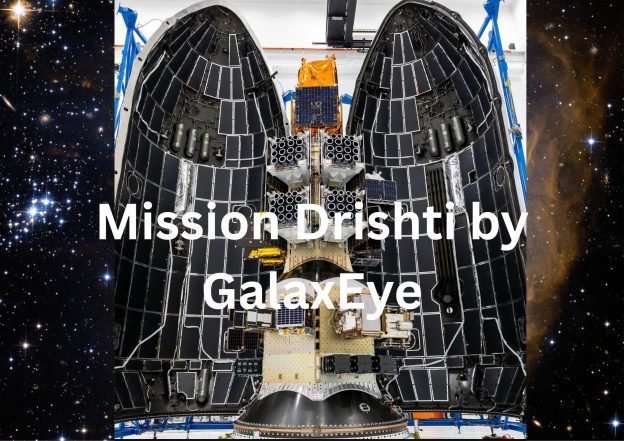
10 Things You Should Know About OptoSAR Satellite, Mission Drishti by GalaxEye
1. World’s First OptoSAR Satellite
Mission Drishti, launched on May 3, 2026, is the world’s first satellite to combine optical and synthetic aperture radar (SAR) sensors on a single platform.
2. Developed by Indian Startup GalaxEye
Built by Bengaluru‑based GalaxEye, founded by IIT Madras alumni in 2021. It marks a major milestone for India’s private space sector.
3. Largest Privately Built Indian EO Satellite
At 190 kg, it is India’s largest privately developed Earth observation satellite to date.
4. Launched by SpaceX Falcon 9
Deployed from Vandenberg Space Force Base, California, aboard a SpaceX Falcon 9 rocket.
5. Dual Sensor Advantage
Optical sensors → clear, high‑resolution images in daylight and clear skies.
SAR sensors → radar imaging that works day or night, through clouds, fog, or rain.
Together, they provide uninterrupted, analysis‑ready data.
6. Solves Traditional Limitations
Conventional satellites rely on either optical or radar. OptoSAR eliminates interruptions caused by weather or low‑light conditions, ensuring continuous monitoring.
7. Applications Across Sectors
Defence surveillance and intelligence.
Disaster management (floods, cyclones, earthquakes).
Agriculture monitoring and crop yield prediction.
Maritime tracking and coastal management.
Urban planning and infrastructure development.
8. Global Commercial Potential
Early interest from government and commercial clients worldwide for reliable geospatial intelligence. GalaxEye has partnered with NewSpace India Limited (NSIL) to distribute imagery globally.
9. Part of India’s Space Expansion
Complements ISRO’s fleet of 29 active Earth observation satellites, strengthening India’s sovereign EO infrastructure.
10. Future Constellation
GalaxEye plans to scale up to a constellation of 10 OptoSAR satellites by 2030, enabling global, high‑frequency coverage.
Why OptoSAR payload Matters?
In a statement, Suyash Singh, Founder & CEO, GalaxEye said, “Mission Drishti marks our first mission and the culmination of over five years of sustained R&D to develop this breakthrough technology. With the satellite now successfully in orbit, our immediate focus is on completing its commissioning. As we move through this phase, we are already witnessing strong global interest in the differentiated datasets enabled by our OptoSAR payload.”
In the context of evolving global requirements for reliable geospatial intelligence, the mission underscores India’s emergence as a credible provider of advanced ISR (Intelligence, Surveillance, and Reconnaissance) capabilities, both domestically and for international partners.
Speaking in the context, Dr Pawan Goenka, Chairman, Indian National Space Promotion and Authorization Center said,
“The sustained effort over the last five to six years on confidence-building, capacity-building, and the commercialisation of India’s private space technology ecosystem is now showing tangible results. Mission Drishti by GalaxEye is a fine example of this – the world’s first OptoSAR satellite from an Indian private player. As more Indian space companies demonstrate their capabilities through real missions and engagement with global customers, confidence in India’s space ecosystem will continue to strengthen, creating greater demand both in India and overseas. I compliment the GalaxEye team on this important milestone and wish them continued success.”
Mission Drishti – Why it is important?
For India: Positions the country at the forefront of private space innovation.
For the World: Provides decision‑grade intelligence for governments, businesses, and disaster relief agencies.
For the Future: A constellation of OptoSAR satellites could redefine global Earth observation standards
OptoSAR satellites like Mission Drishti are game‑changers — combining clarity and persistence to deliver uninterrupted, high‑quality Earth data, making India a leader in next‑gen satellite imaging.
Key Highlights OptoSAR
Startup: GalaxEye, founded in 2021 by IIT Madras alumni, based in Bengaluru.
Satellite Name: Drishti — India’s largest privately built Earth observation satellite (approx. 190 kg).
Launch Date & Vehicle: May 3, 2026, aboard SpaceX Falcon 9 from Vandenberg Space Force Base, California.
Technology: OptoSAR — integrates optical sensors (clear, intuitive images) with Synthetic Aperture Radar (SAR) (penetrates clouds, works at night).
Global First: No other satellite has previously combined both sensors simultaneously on one platform.
What are SAR Sensors?
SAR sensors are the heart of Synthetic Aperture Radar (SAR) technology, used in satellites and aircraft for Earth observation.
What SAR Sensors Do?
Radar Imaging: They send microwave signals toward Earth and record the echoes that bounce back.
Synthetic Aperture: By moving along a flight path (satellite orbit or aircraft), the sensor combines signals over time to create a “synthetic” large antenna — giving very high‑resolution images.
All‑Weather Capability: Unlike optical cameras, SAR sensors can “see” through clouds, fog, smoke, and even at night, because microwaves don’t rely on sunlight.
Key Features
Microwave Frequency Bands: Operate in bands like X, C, L, or S, each with different penetration and resolution properties.
Surface Penetration: Some bands can penetrate vegetation, soil, or ice, revealing hidden structures.
High Resolution: Can detect changes as small as a few centimeters.
Applications:
Disaster monitoring (floods, landslides, earthquakes).
Defence and surveillance.
Agriculture (crop health, soil moisture).
Climate studies (glacier movement, deforestation).